For Logan and his family, every single day felt heavy.
The kind of heavy where leaving the house felt impossible.
The kind of heavy where a trip to the grocery store ended in tears.
The kind of heavy where even playdates weren’t worth the risk.
From his earliest years, Logan struggled with intense sensory overload. His body couldn’t regulate. His emotions felt explosive. His reactions were unpredictable and overwhelming — for him and for everyone around him.
Restaurants? Not possible.
Crowded places? Out of the question.
School? His parents dreaded what would happen when the meltdowns followed him there.
At one point, Logan cut himself badly and was bleeding — but he didn’t react to the pain. Instead, he was distressed by the feeling of the blood running down his arm.
That’s not misbehavior.
That’s not defiance.
That’s a nervous system in complete overload.
Eventually, Logan received not only a Sensory Processing Disorder diagnosis, but also an autism diagnosis. His early years were anything but easy.
But here’s the part his parents couldn’t see yet:
Logan’s story wasn’t over.
Today, he’s a thriving honor roll student.
And the turning point wasn’t a behavior chart or another coping strategy.
It was understanding his nervous system.
What Is Sensory Overload — Really?
Most people describe sensory overload as “being overwhelmed.”
But neurologically, it’s deeper than that.
Sensory overload happens when a child’s brain struggles to properly process and filter the sensory information coming in from the world around them.
Sounds.
Lights.
Movement.
Touch.
Smells.
Emotions in the room.
For some kids, it’s like the volume knob is turned all the way up — and the filter that’s supposed to block out unimportant noise isn’t working.
Instead of sorting information effectively, their nervous system lets too much in.
And when that happens, the brain shifts into survival mode.
What Sensory Overload Looks Like at Home
Parents often notice:
-
Covering ears in loud environments
-
Meltdowns in grocery stores or classrooms
-
Extreme reactions to tags, clothing, or touch
-
Anxiety in crowded spaces
-
Difficulty focusing
-
Irritability or constant edge
-
Shutting down or trying to escape situations
Sometimes it looks like tantrums.
Sometimes it looks like anxiety.
Sometimes it looks like “defiance.”
But underneath it all?
It’s physiology.
When a child’s nervous system is overwhelmed, their body prioritizes survival — not regulation, not learning, not social engagement.
And over time, if sensory overload is constant, it can impact development. The brain becomes so busy managing incoming noise that it misses important learning signals needed for coordination, speech, behavior, and emotional regulation.
The Nervous System’s Role in Sensory Processing
To understand sensory overload, we have to understand the nervous system.
The nervous system has three primary jobs:
-
Perception – Receiving input from inside and outside the body
-
Integration – Filtering and organizing that information
-
Action – Creating appropriate responses
When everything works well, the brain filters out unnecessary noise and keeps important information.
When it doesn’t?
Too much “noise” gets through.
Dr. Bruce Lipton puts it beautifully:
“The function of the nervous system is to perceive the environment and coordinate the behavior of all cells in the body.”
If perception and coordination are disrupted, behavior will be too.
The Real Root: Subluxation + Dysautonomia
Two words most parents have never heard — but they matter deeply:
Subluxation
Dysautonomia
Let’s simplify.
When stress impacts the spine and nervous system — especially in the upper neck and brainstem — it can disrupt how sensory information is processed. In chiropractic, we call this subluxation.
When that disruption throws off the balance between the fight-or-flight (sympathetic) system and the calming (parasympathetic) system, we call that dysautonomia.
And sensory overload is often a direct reflection of this imbalance.
Instead of having a flexible nervous system that can adapt to stress, these kids are stuck in:
-
Excess sympathetic tone (gas pedal stuck down)
-
Suppressed vagus nerve function (brake pedal not working well)
The vagus nerve — responsible for calming, digestion, immune function, and emotional regulation — is especially vulnerable during birth.
Interventions like C-sections, inductions, forceps, and vacuum extraction can create physical stress at the brainstem.
Again — this is not about blame.
It’s about understanding how early stress can shape neurological regulation.
“Noisy Brain Syndrome”
We often describe sensory overload as a “noisy brain.”
There are two types of input constantly reaching the brain:
Nociception – Stressful, irritating, chaotic signals
Proprioception – Movement-based, organizing signals
When subluxation is present, proprioceptive input decreases and nociceptive “noise” increases.
The brain becomes overwhelmed by stress signals.
When the noise gets too loud?
Meltdowns.
Shutting down.
Explosive reactions.
Inability to self-soothe.
It’s not a character issue.
It’s a neurological traffic jam.
Why Avoidance Isn’t Enough
Traditional approaches often focus on coping:
-
Avoid triggers
-
Wear headphones
-
Reduce stimulation
-
Practice calming strategies
Those tools can help — and sometimes they’re necessary.
But they don’t address why the nervous system is overwhelmed in the first place.
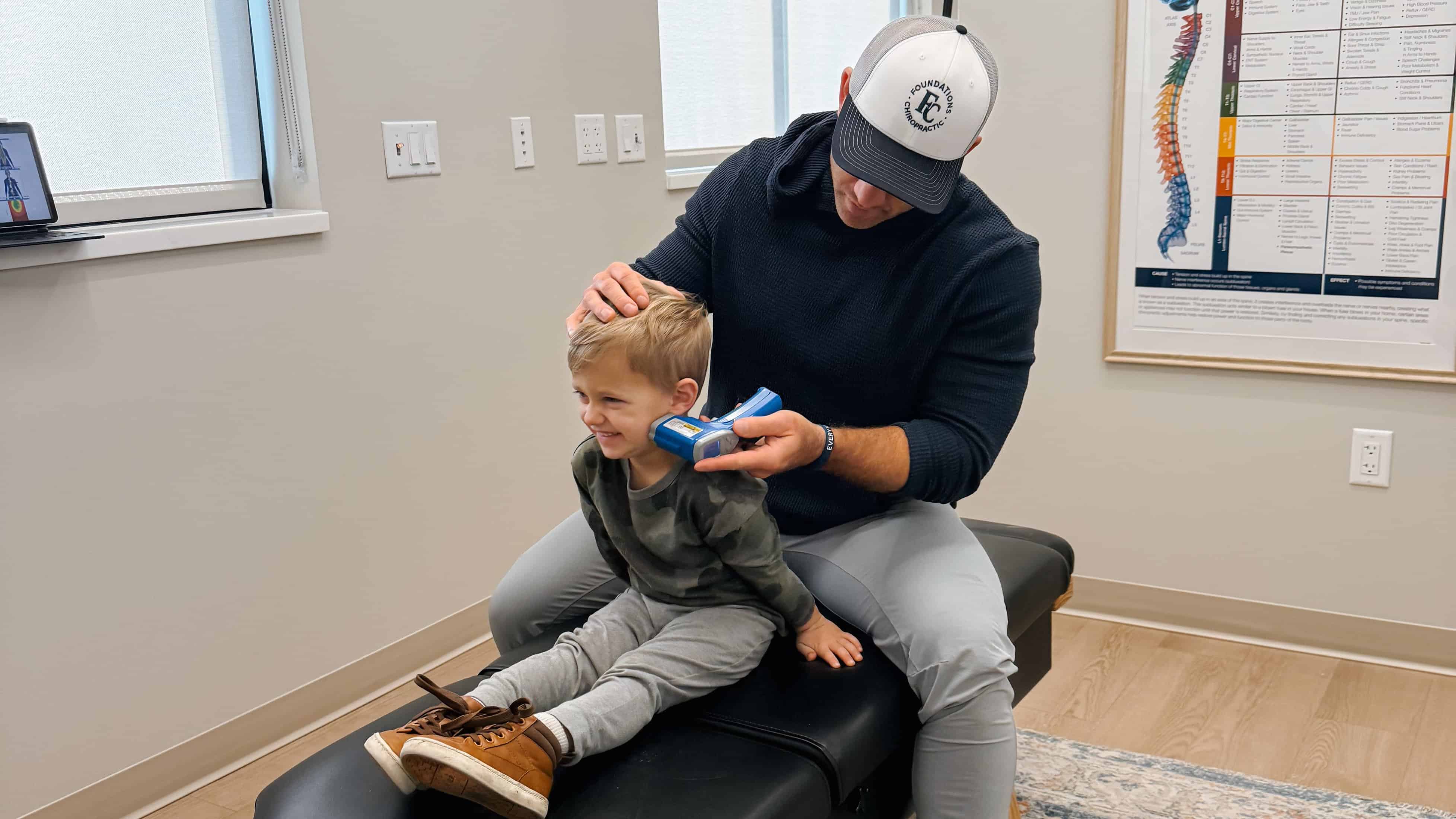
At Foundations Chiropractic, we focus on restoring balance to the Autonomic Nervous System.
Not suppressing symptoms.
Not medicating behavior.
But improving neurological regulation at its foundation.
Measuring What Matters: INSiGHT Scans
Instead of guessing, we measure.
Our INSiGHT Scans objectively assess:
-
HRV (Heart Rate Variability) – Is the system flexible or stuck?
-
Surface EMG – How much stress and tension is locked in the spine?
-
Thermal Scanning – Are there signs of autonomic imbalance?
For children with sensory overload, the EMG scan is especially revealing.
It measures how much stress (nociception) is pent up in the system.
When parents see these scans, many get emotional — because it finally makes sense.
There’s a reason their child feels overwhelmed.
And more importantly — there’s a path forward.
Logan’s Turning Point
When Logan’s family addressed his nervous system — not just his behavior — things began to change.
Gradually, his system became more regulated.
His reactions softened.
His focus improved.
His resilience increased.
Today, he’s thriving academically and socially.
Not because he learned to “try harder.”
But because his nervous system finally had the capacity to regulate.
If This Sounds Like Your Child…
If public outings feel impossible…
If meltdowns feel unpredictable…
If your child seems overwhelmed by the world…
You are not alone.
And your child is not broken.
Sensory overload is not a behavior problem.
It’s a nervous system problem.
And when we support the nervous system, everything else — behavior, learning, emotional regulation — begins to improve from the inside out.
If you’re ready to stop chasing symptoms and start addressing the foundation, our team at Foundations Chiropractic would be honored to walk that journey with you.
Because overwhelmed doesn’t have to be permanent.
And your child’s story isn’t over yet.