You’ve been waiting for that first word.
Then the next one.
And the next.
Maybe you’ve watched other children the same age begin putting sentences together while your little one is still struggling to communicate what they want.
Maybe your child understands everything you say but has difficulty getting the words out.
Or maybe they’re talking, but their words are so difficult to understand that everyday conversations turn into frustration.
As a parent, you know your child better than anyone.
You see their personality.
Their intelligence.
Their curiosity.
Their desire to connect with the people around them.
And when speech isn’t developing the way you expected, it’s natural to start asking questions.
Why aren’t the words coming?
Why does communication seem so difficult?
And what might be happening beneath the surface?
What if understanding your child’s speech delay starts with looking beyond speech itself?
At Foundations Chiropractic, we’re passionate about helping parents understand the incredible relationship between the brain, nervous system, movement, and development.
Because speech is about so much more than learning words.
It’s an intricate neurological process that depends on communication, coordination, sensory input, and motor planning.
And understanding that bigger picture is an important part of our neurologically-focused approach.
What Is a Speech Delay in Children?
A speech delay occurs when a child’s ability to produce speech sounds and words develops more slowly than expected for their age.
For some children, that means their first words come later.
For others, it means they have difficulty pronouncing certain sounds, combining words, or making themselves understood.
And for many families, speech challenges become most noticeable when children begin wanting to communicate more complex thoughts and ideas.
Think about everything that happens when your child says something as simple as “I want water.”
Their brain must plan the message.
It must organize the sounds needed to produce those words.
The muscles of the tongue, lips, jaw, and throat must coordinate precise movements.
Those movements must occur in the correct sequence.
And the brain must continually process sensory feedback to help produce understandable speech.
All of this happens in a matter of seconds!
Speech is one of the most remarkable examples of brain-body coordination.
And when a child struggles with speech development, understanding the different parts of that process can provide valuable insight into what they’re experiencing.
Speech Delay vs. Language Delay: What’s the Difference?
Although the terms are often used interchangeably, speech and language aren’t exactly the same thing.
Speech is how we physically produce sounds and words.
A child with a speech delay may know what they want to say but struggle to pronounce words clearly or coordinate the movements needed to produce them.
Language is how we understand and communicate meaning.
A child with a language delay may have difficulty understanding words, following directions, putting thoughts into sentences, or communicating ideas.
Language development also involves two important components.
Receptive Language
Receptive language is what your child understands.
For example, your toddler might understand when you ask them to bring you their shoes, find their favorite stuffed animal, or put a toy away.
Even if they’re not speaking very much, they may understand a great deal of what you’re saying.
Expressive Language
Expressive language is how your child communicates their thoughts, wants, and needs.
This may include spoken words, gestures, signs, or other forms of communication.
For some children, receptive language develops much more quickly than expressive language.
They understand what everyone is saying but struggle to express themselves.
And that disconnect can be incredibly frustrating.
At Foundations Chiropractic, we believe it’s important to recognize these differences while understanding each child’s unique developmental story.
Speech Development Milestones: What Should Parents Look For?
Every child develops at their own pace.
Some children begin talking early, while others take a little more time to build their vocabulary.
Developmental milestones provide helpful reference points for understanding how communication typically progresses.
Here’s a general overview of what parents may notice during the early years.
Around 12 Months
Many babies are beginning to:
-
Babble using a variety of sounds
-
Respond to familiar voices and sounds
-
Use gestures such as pointing or waving
-
Recognize familiar words
-
Begin saying one or two meaningful words
Around 18 Months
Children are often beginning to:
-
Use several meaningful words
-
Attempt to imitate sounds and words
-
Point to familiar objects
-
Follow simple directions
-
Communicate wants and needs through words and gestures
Around 24 Months
By their second birthday, many children are beginning to:
-
Use an expanding vocabulary
-
Combine two words into simple phrases
-
Follow familiar directions
-
Identify common objects
-
Communicate more intentionally
Around 3 Years
Many children are beginning to:
-
Speak in short sentences
-
Ask questions
-
Participate in simple conversations
-
Communicate ideas and needs more clearly
-
Be understood much of the time by familiar people and increasingly by others
Around 4 Years
Children are often able to:
-
Use longer, more detailed sentences
-
Tell simple stories
-
Talk about things that happened earlier
-
Ask and answer more complex questions
-
Communicate clearly enough to be understood in most everyday situations
These milestones aren’t rigid deadlines.
But they can help parents recognize when their child’s communication development deserves a closer look.
And at Foundations Chiropractic, we always encourage parents to pay attention to what they’re noticing.
You know your child. Your observations matter.
Signs Your Child May Be Struggling With Speech Development
Sometimes, speech delays are easy to recognize.
Other times, the signs can be more subtle.
Parents may notice:
-
Limited babbling or attempts to communicate
-
Few spoken words compared with expected milestones
-
Difficulty combining words into phrases
-
Trouble pronouncing certain sounds
-
Speech that is difficult for others to understand
-
Frustration when trying to communicate
-
Difficulty imitating sounds or words
-
Challenges following simple directions
-
Limited use of gestures or other forms of communication
-
Difficulty coordinating the mouth movements needed for speech
A loss of previously learned words or skills, or little response to sounds, is especially important to recognize and deserves prompt evaluation.
When parents notice ongoing developmental concerns, gathering information early can help them make informed decisions about their child’s needs.
At Foundations Chiropractic, we believe in taking those concerns seriously and listening closely to each family’s story.
Why Speech Development Is Connected to the Nervous System
Here’s where the conversation gets especially interesting.
Speech doesn’t begin in the mouth. It begins in the brain.
Before your child can produce a word, their nervous system must coordinate a complex series of events.
Different areas of the brain work together to organize language, plan movements, and process sensory information.
The nervous system then coordinates the muscles needed to produce speech.
And as those movements happen, sensory feedback helps the brain adjust and refine them.
Think of it as an incredibly sophisticated communication network.
Your child doesn’t simply decide to say something and move their mouth.
Their brain must organize what they want to communicate and coordinate the physical actions needed to make it happen.
This is one reason we’re so passionate about the relationship between movement, sensory input, and the nervous system at Foundations Chiropractic.
Because the nervous system plays a foundational role in how children experience, interact with, and learn from the world around them.
Why Movement Matters for Brain Development
Long before a child begins speaking in sentences, their nervous system is already learning through movement.
Lifting their head.
Reaching for toys.
Rolling.
Sitting.
Crawling.
Standing.
Walking.
Every new movement provides valuable sensory information to the brain.
Through movement, children learn about their bodies, their surroundings, balance, coordination, and spatial awareness.
This process involves something called proprioception.
Proprioception is the body’s ability to sense its position and movement.
Specialized receptors in muscles and joints continually provide information that helps the brain coordinate movement.
And that ongoing communication is essential for developing body awareness and motor skills.
Speech also requires motor planning and coordination, although its development involves specialized neural pathways and doesn’t depend on every physical milestone occurring in one exact order.
At Foundations Chiropractic, we’re interested in the bigger picture of how children move and develop.
Because when we look at a child’s overall movement patterns, posture, muscular tension, and physical comfort, we gain valuable information about their individual needs.
When Speech Delays Come Alongside Other Challenges
Something many parents notice is that speech delays aren’t always the only concern.
Maybe your child also struggled with feeding as a baby.
Maybe they had difficulty turning their head comfortably.
Maybe they’ve experienced sensory sensitivities, motor delays, or challenges with emotional regulation.
Or maybe they’ve always seemed to have difficulty settling down and adapting to changes in their environment.
For some families, speech challenges occur alongside:
-
Delayed motor milestones
-
Low muscle tone
-
Coordination difficulties
-
Sensory sensitivities
-
Emotional outbursts
-
Difficulty with transitions
-
Sleep struggles
-
Feeding challenges
-
Physical tension or discomfort
These experiences can have different causes, but they also provide important context for understanding the whole child.
At Foundations Chiropractic, we believe that every part of your child’s story matters.
We want to know about their speech development, but we also want to understand their movement, physical comfort, sensory experiences, sleep, and daily routines.
Because your child is so much more than one developmental milestone.
The Gas Pedal and Brake Pedal: Understanding Nervous System Regulation
One of our favorite ways to explain the Autonomic Nervous System at Foundations Chiropractic is through the gas pedal and brake pedal analogy.
The Autonomic Nervous System helps regulate functions your child’s body performs automatically, including heart rate, digestion, breathing, and responses to stress.
It has two major branches that work together.
The Sympathetic Nervous System: The Gas Pedal
The sympathetic nervous system is the body’s fight-or-flight response.
When your child experiences stress, excitement, or something overwhelming, this system helps prepare their body to respond.
Their heart rate may increase.
Their muscles become more alert.
Their body prepares for action.
The Parasympathetic Nervous System: The Brake Pedal
The parasympathetic nervous system supports rest, digestion, recovery, and the body’s return toward a calmer state.
Both systems are important.
And the ability to move between activity and recovery is part of healthy nervous system regulation.
For children already working hard to communicate, stress can make difficult situations feel even more overwhelming.
Imagine trying to find the right words when you’re frustrated, tired, or nervous.
Now imagine experiencing that challenge while your speech and communication skills are still developing.
This helps explain why some children become especially frustrated when they cannot communicate their needs.
At Foundations Chiropractic, understanding the nervous system’s role in stress, sensory experiences, and physical comfort is a central part of our approach.
The Vagus Nerve and Brain-Body Communication
Another important part of the nervous system conversation is the vagus nerve.
The vagus nerve is a major component of the parasympathetic nervous system.
It connects the brainstem with several important organs, including the heart, lungs, and digestive tract.
It helps coordinate functions such as:
-
Heart rate regulation
-
Digestive activity
-
Recovery following stress
-
Communication between the gut and brain
-
Certain aspects of voice production and swallowing
Speech involves a much broader network of brain regions, nerves, and muscles, but the vagus nerve is one example of how interconnected the nervous system really is.
At Foundations Chiropractic, we love helping families understand these relationships.
The more we understand about the body’s communication systems, the more we can appreciate the remarkable coordination involved in everyday development.
The Perfect Storm: Looking at Your Child’s Bigger Story
At Foundations Chiropractic, we frequently discuss a concept called The Perfect Storm.
This framework encourages us to look at the many physical, emotional, and environmental experiences that may influence a child’s health and development.
Sometimes, that story begins during pregnancy.
Maybe mom experienced significant stress or discomfort.
Maybe the birth was long, difficult, or involved unexpected interventions.
Perhaps there were early feeding challenges, sleep difficulties, or other concerns during infancy.
As children grow, they encounter even more experiences that influence how they move, learn, and adapt.
The Perfect Storm helps us remember that there is often more to a child’s history than the symptoms we see today.
Speech delays can arise for many reasons, and a particular birth experience or stressor doesn’t automatically explain why a child is struggling to communicate.
But understanding those experiences can help us recognize important aspects of their development and physical function.
At Foundations Chiropractic, we take time to learn that history.
Not simply when speech became a concern, but what your child’s entire developmental journey has looked like.
Because we believe meaningful care begins with understanding the whole story.
Understanding Subluxation Through a Neurologically-Focused Approach
At Foundations Chiropractic, we take a special interest in the relationship between the spine, movement, and nervous system function.
One concept we discuss in chiropractic is subluxation.
In our chiropractic framework, subluxation involves changes in spinal joint movement, positioning, and associated neuromuscular function.
Our doctors assess the spine and surrounding structures to understand patterns of movement, muscular tension, posture, and physical function.
Why does movement matter?
Because muscles and joints are constantly sending information to the brain.
That sensory feedback plays a role in body awareness, coordination, and motor control.
Through gentle, specific chiropractic adjustments, our doctors aim to support movement, neuromuscular function, and physical comfort.
For children navigating developmental challenges, we believe it’s valuable to understand these foundational aspects of physical health.
Every child has different needs, and our neurologically-focused approach reflects that individuality.
How INSiGHT Scans Help Us Look Deeper
One of the things that makes Foundations Chiropractic unique is our use of INSiGHT Scanning Technology.
These gentle, non-invasive assessments give our doctors additional information about specific physiological patterns related to autonomic and neuromuscular activity.
Our technology includes three components.
Heart Rate Variability (HRV)
HRV measures the small variations in time between heartbeats.
These measurements provide information about aspects of autonomic nervous system activity and physiological responses.
Surface Electromyography (sEMG)
Surface EMG measures electrical activity associated with muscle activation.
This allows our doctors to observe patterns of neuromuscular activity and muscular tension.
NeuroThermal Scanning
NeuroThermal Scanning measures temperature differences along the surface of the skin.
These measurements provide additional information about physiological patterns during our assessment process.
Together, these scans allow our doctors to gather information that goes beyond a conversation about symptoms alone.
We combine them with your child’s health history, physical examination, movement assessment, and individual goals.
We also use follow-up INSiGHT Scans to observe changes over time.
For families seeking a deeper understanding of their child’s physical function and nervous system health, this process is an important part of what we offer at Foundations Chiropractic.
Why We Look Beyond the Speech Delay
When a family comes to Foundations Chiropractic because their child is struggling with speech development, we want to hear more than how many words their child can say.
We want to know:
What has your child’s development looked like from the beginning?
Were there challenges during pregnancy or birth?
Did they struggle with feeding or sleeping as an infant?
How are they moving?
Are they experiencing physical tension or discomfort?
How do they respond to sensory experiences?
What does everyday life look like for your family?
And most importantly, what are your hopes and goals for your child?
These questions help us develop a more complete picture of the child sitting in front of us.
Because every child has a unique story.
And at Foundations Chiropractic, we believe their care should be just as individualized.
What to Expect at Foundations Chiropractic
If you’re curious about our neurologically-focused approach, here’s what getting started looks like.
Step 1: Initial Consultation and INSiGHT Scans
Your first visit is all about understanding your child’s story.
We’ll discuss their health history, developmental experiences, physical concerns, and the goals that matter most to your family.
We’ll also complete an individualized assessment, including INSiGHT Scans when appropriate.
This gives our doctors valuable information to consider as we develop recommendations for your child.
Step 2: Your Personalized Report of Findings
At your second visit, we’ll sit down and review what we’ve learned.
Our doctors will walk you through the assessment findings, explain our approach, and discuss personalized chiropractic care recommendations.
We want you to understand what we’re looking at and feel confident in the process.
If care is recommended and your family decides to move forward, this is also when your child can receive their first adjustment.
Step 3: Gentle, Neurologically-Focused Adjustments
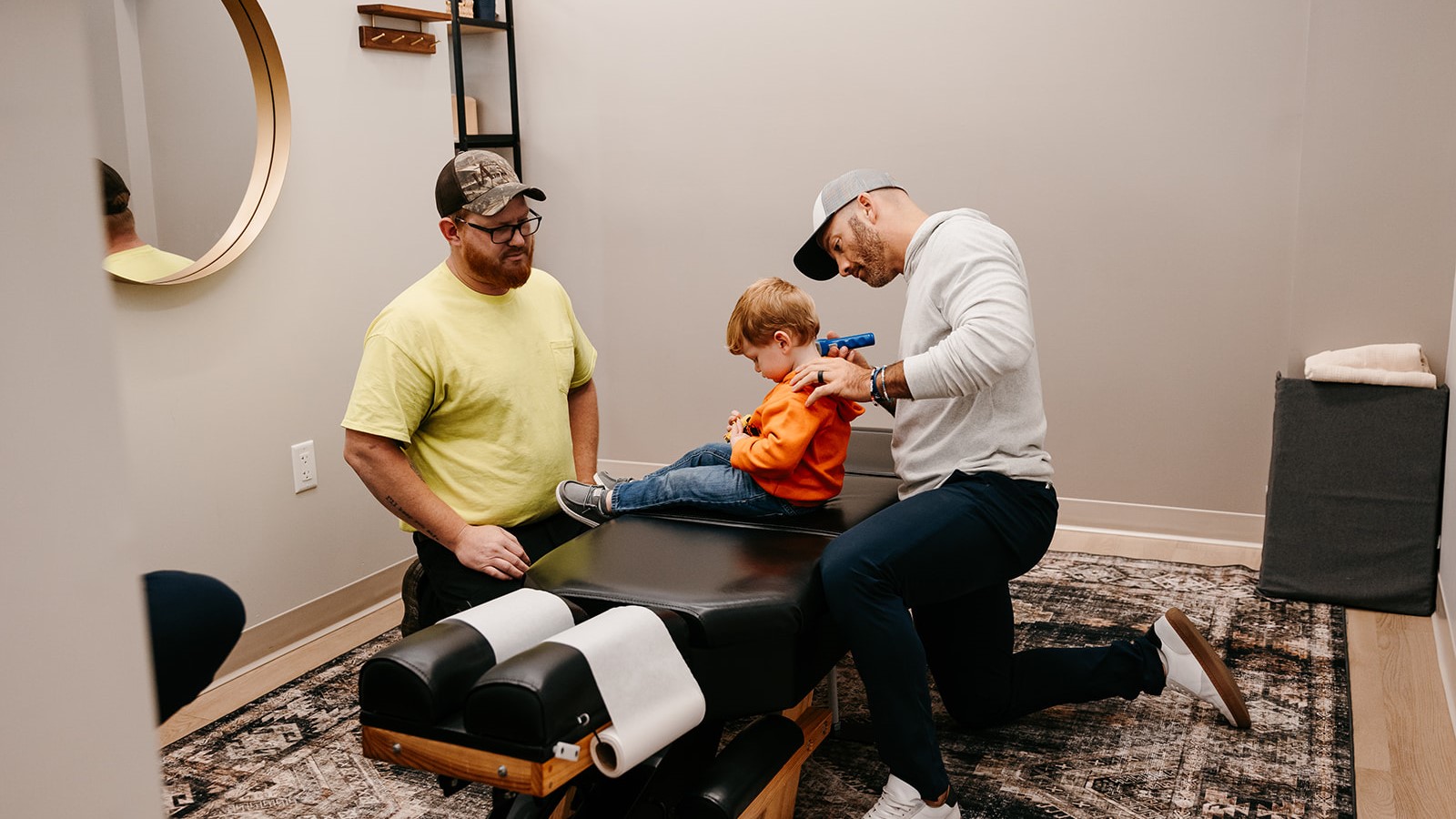
Our doctors use gentle, specific chiropractic techniques tailored to your child’s age, size, physical findings, and individual needs.
Our focus is on supporting musculoskeletal comfort, movement, and neuromuscular function.
And because every child is different, care is always personalized.
Step 4: Tracking and Celebrating Progress
Throughout care, we pay attention to both our clinical findings and the everyday changes families share with us.
Progress INSiGHT Scans help us observe physiological patterns over time.
We also love hearing about the little victories happening at home.
Because those everyday moments are often what mean the most to parents.
Celebrating the Little Wins
When your child is struggling with speech development, it’s natural to focus on the big milestones.
The first word.
The first clear sentence.
The first time they tell you about their day.
Those are incredible moments.
But there are so many other victories worth celebrating along the way.
Maybe your child is finding new ways to communicate what they need.
Maybe they’re participating more comfortably in family activities.
Maybe they’re feeling more confident around other children.
Maybe they’re moving with greater ease.
Or maybe everyday routines are beginning to feel a little less overwhelming.
Every child’s progress looks different.
And at Foundations Chiropractic, we love celebrating the milestones that matter most to each family.
Your Child Has So Much More to Say
One of the most important things we want parents navigating speech delays to understand is that communication is about so much more than spoken words.
Your child has thoughts.
Feelings.
Ideas.
Interests.
A unique personality.
And their own way of experiencing the world.
Even when speech is difficult, there are so many meaningful ways to connect, communicate, and grow.
A speech delay doesn’t define your child’s intelligence, personality, or potential.
And their developmental journey is about much more than reaching one particular milestone.
At Foundations Chiropractic, we believe every child deserves to be seen, heard, and understood as a whole person.
That’s why we focus on learning their story, understanding their individual needs, and providing personalized care.
Looking Beyond Speech Delays at Foundations Chiropractic
If you’ve been wondering why your child’s speech isn’t progressing the way you expected, we would love the opportunity to hear your family’s story.
At Foundations Chiropractic, we’re passionate about the incredible connection between the brain, nervous system, movement, and development.
Our neurologically-focused approach includes detailed consultations, INSiGHT Scanning Technology, individualized assessments, and gentle, specific chiropractic adjustments.
We focus on supporting physical function, movement, comfort, and overall well-being while recognizing the unique developmental experiences of every child.
We believe parents deserve to feel heard.
We believe children’s health deserves a bigger-picture perspective.
And we believe understanding the nervous system is an important part of building a strong foundation for lifelong wellness.
Start Your Family’s Journey at Foundations Chiropractic
If your child is experiencing speech delays, communication challenges, or other developmental concerns, we’d love to welcome your family to Foundations Chiropractic in Fountain City, Wisconsin.
Our team is passionate about helping families better understand their child’s health and providing compassionate, individualized neurologically-focused care.
Because behind every delayed word is a child with an incredible story, a unique personality, and so much potential. And at Foundations Chiropractic, we’re passionate about supporting the foundation that helps every child grow.