You can see it in their eyes.
Your child has something they want to tell you.
Maybe they’re excited about something they saw.
Maybe they’re trying to ask for their favorite snack.
Maybe they want to tell you about their day, share a funny story, or simply say, “I love you.”
But the words just won’t come out the way they want them to.
They try.
They pause.
They try again.
And sometimes, the frustration becomes so overwhelming that the moment ends in tears, a meltdown, or giving up altogether.
As a parent, watching your child struggle to communicate can be incredibly difficult.
You know how much they understand.
You see their personality shining through.
You know how much they have to say.
And you want nothing more than for them to be able to share their thoughts, feelings, and experiences with the world.
For some families, these challenges eventually lead to a diagnosis of Childhood Apraxia of Speech (CAS).
But what exactly is apraxia?
Why can a child know precisely what they want to say but struggle to produce the words?
And what role does the nervous system play in the complicated process of speech?
At Foundations Chiropractic, we’re passionate about helping families better understand the incredible connection between the brain, nervous system, movement, and development.
Because speech is about so much more than simply moving the mouth.
It’s a complex neurological process that depends on precise communication and coordination throughout the body.
What Is Childhood Apraxia of Speech?
Childhood Apraxia of Speech, often called CAS or simply apraxia, is a neurological speech disorder that affects a child’s ability to plan and coordinate the movements needed for speech.
Here’s what makes apraxia unique.
A child with apraxia may know exactly what they want to say, but their brain has difficulty planning and sequencing the movements needed to produce those words.
Think about all the things that need to happen for you to say a single sentence.
Your brain must plan the sounds.
Your lips need to move into specific positions.
Your tongue must coordinate incredibly precise movements.
Your jaw, soft palate, and other speech structures all need to work together.
And those movements must happen in the correct sequence, with the right timing.
For most of us, this happens so automatically that we rarely think about it.
But for a child with apraxia, planning those movements can be incredibly challenging.
It’s not necessarily that the muscles are weak.
It’s that coordinating the movements required for speech is difficult.
Imagine knowing exactly where you want to go but struggling to organize the directions needed to get there.
That’s one way to understand childhood apraxia.
The destination is clear.
But the steps needed to reach it aren’t coming together as easily.
What Does Apraxia of Speech Look Like in Children?
Apraxia can look different from one child to the next.
Some children have difficulty producing even simple words.
Others can say certain sounds or familiar phrases but struggle when they attempt something new.
And some children seem to pronounce a word successfully one moment but have difficulty saying that same word again.
Parents may notice:
-
Delayed development of spoken words
-
Difficulty putting sounds together into words
-
Inconsistent pronunciation of the same word
-
More difficulty with longer or more complicated words
-
Unusual pauses between syllables
-
Difficulty transitioning smoothly from one sound to another
-
Visible effort when attempting to speak
-
Differences in speech rhythm or emphasis
-
Frustration when others cannot understand what they’re saying
-
Reliance on gestures, pointing, or other ways of communicating
For many families, one of the most challenging parts is seeing the difference between what their child understands and what they can express.
Their thoughts may be moving much faster than their ability to communicate them.
And that can affect everyday experiences in ways other people may not fully appreciate.
Why Speech Is Really a Nervous System Process
At Foundations Chiropractic, we talk a lot about brain-body communication.
And speech is a fascinating example of just how complex that communication really is.
When your child speaks, multiple areas of the brain work together to plan, organize, and coordinate movement.
These include regions involved in language, motor planning, timing, sequencing, and sensory feedback.
The nervous system helps coordinate the muscles that control the lips, tongue, jaw, and other structures involved in producing speech.
Sensory information also plays an important role.
As your child practices producing sounds, their brain receives information about how those movements feel and what they sound like.
This feedback helps refine speech movements over time.
It’s an incredibly detailed process.
And it reminds us that communication is not just about knowing words. It’s also about coordinating the movements needed to express them.
That’s why we’re so interested in neuromuscular function and the developing nervous system at Foundations Chiropractic.
The relationship between movement, sensory information, and the brain is an important part of understanding how children learn and develop new skills.
The Connection Between Motor Planning and Speech
One important term in understanding apraxia is motor planning.
Motor planning is the brain’s ability to organize and coordinate the movements needed to complete an action.
Think about a child learning to ride a bike.
At first, they have to think about balancing, steering, pedaling, and coordinating their body.
Over time, those movements become more familiar and automatic.
Speech also depends on complex motor planning.
The brain must coordinate a sequence of movements with remarkable speed and precision.
Children with apraxia experience difficulty with this speech-specific planning process.
Some children may also experience broader motor coordination challenges, although this isn’t true for everyone.
You might notice difficulties with certain physical activities, fine motor tasks, or learning new movement sequences.
These observations can provide helpful context when understanding a child’s overall development.
At Foundations Chiropractic, we pay attention to the relationship between movement, body awareness, and neuromuscular function as part of our whole-child approach.
When Speech Challenges Affect More Than Communication
One of the hardest parts of apraxia is that the struggle doesn’t always end with speech.
Imagine having so much you want to communicate but not always being able to make yourself understood.
For a young child, that can be incredibly frustrating.
Sometimes, that frustration shows up as behavioral challenges.
A child may become overwhelmed when trying to express what they need.
They may become upset when someone misunderstands them.
They may avoid certain social situations.
Or they may struggle during activities that involve lots of communication, unfamiliar people, or sensory input.
For some families, speech challenges occur alongside other concerns, such as:
-
Sensory sensitivities
-
Difficulty with transitions
-
Emotional outbursts or meltdowns
-
Motor coordination challenges
-
Sleep difficulties
-
Physical tension or discomfort
-
Difficulty adapting to busy environments
These experiences can have different explanations, but they remind us how closely a child’s physical, emotional, and developmental experiences can interact.
When communication is difficult, even simple everyday moments can become much bigger challenges.
And that’s why we believe it’s important to see the whole child, not just the speech difficulty.
The Nervous System’s Role in Regulation and Communication
Your child’s nervous system is involved in much more than producing movement.
It also helps coordinate sensory processing, attention, stress responses, and many of the body’s automatic functions.
At Foundations Chiropractic, we often explain the Autonomic Nervous System using the gas pedal and brake pedal analogy.
The sympathetic nervous system is the gas pedal.
This system helps prepare the body to respond to stress, excitement, and challenges.
When activated, it can increase heart rate, muscle alertness, and overall physiological arousal.
The parasympathetic nervous system is the brake pedal.
This system supports rest, digestion, and recovery after stress.
Both systems are important.
And for children navigating communication challenges, understanding how stress affects their ability to participate in everyday activities can be especially valuable.
Think about how much harder it can be to find the right words when you’re nervous or frustrated.
Now imagine a child who is already working incredibly hard to plan and produce speech movements.
Adding emotional or sensory overwhelm can make a challenging moment feel even more difficult.
This is why creating opportunities for comfort, connection, and regulation matters so much for growing children.
The Vagus Nerve and Brain-Body Communication
Another important part of our nervous system conversations at Foundations Chiropractic is the vagus nerve.
The vagus nerve is a major component of the parasympathetic nervous system.
It connects the brainstem with several important organs and participates in functions such as heart rate regulation, digestion, and recovery following stress.
It also contributes to the function of structures involved in voice production and swallowing.
Speech itself involves a much broader network of brain regions, cranial nerves, sensory pathways, and muscles working together.
Understanding these connections helps illustrate just how much coordination happens throughout the nervous system during everyday activities.
And it’s one reason we’re passionate about helping parents understand the body’s remarkable communication network.
The Perfect Storm: Understanding Your Child’s Bigger Story
At Foundations Chiropractic, we often talk about a concept called The Perfect Storm.
It’s a framework we use to look at the bigger picture of someone’s health and development.
Rather than focusing on one symptom or one moment, we take time to understand the experiences and stressors that have shaped a child’s life.
For some families, that history includes a stressful pregnancy.
For others, it involves a challenging birth experience, early feeding difficulties, physical discomfort, disrupted sleep, or sensory challenges.
As children grow, their experiences continue influencing how they move, learn, respond to stress, and navigate the world around them.
Childhood apraxia has complex neurological origins, and many cases do not have one identifiable cause.
A difficult birth or early-life stressor does not automatically explain an apraxia diagnosis.
But understanding a child’s complete history gives us valuable context when assessing their overall physical function and individual needs.
At Foundations Chiropractic, we believe that story matters.
Because every child deserves to be understood as more than a collection of symptoms.
What Is Subluxation, and Why Do We Talk About It?
At Foundations Chiropractic, we take a neurologically-focused approach to chiropractic care.
Part of that approach involves assessing spinal movement, muscular tension, posture, and patterns of neuromuscular function.
In chiropractic, the term subluxation is used to describe patterns involving altered joint movement, positioning, and associated neuromuscular findings.
Movement provides valuable sensory information to the brain through receptors in our muscles and joints.
This information contributes to body awareness, coordination, posture, and the control of movement.
Our doctors are interested in how these physical patterns relate to each child’s overall function and comfort.
When we assess a child, we look at their movement, muscular activity, and physical findings to determine an individualized chiropractic approach.
For children navigating complicated developmental challenges, we believe there’s value in paying attention to these foundational aspects of physical health.
Why We Look Beyond the Speech Delay
One thing we hear from parents is that their child’s challenges rarely seem to fit neatly into one category.
A child may be struggling with speech development while also experiencing sensory sensitivities.
Another may have difficulty with motor coordination and feel easily overwhelmed in busy places.
Another may be navigating sleep challenges, physical tension, and difficulty with transitions.
These experiences can affect different parts of daily life.
And they are all meaningful pieces of that child’s story.
At Foundations Chiropractic, our approach begins with understanding the child as a whole.
We want to know about their development.
Their physical comfort.
Their movement patterns.
Their pregnancy and birth history.
Their sensory experiences.
Their daily routines.
And the goals that matter most to their family.
Because to us, the child is always more important than the diagnosis.
How INSiGHT Scans Help Us Take a Closer Look
One of the things that makes Foundations Chiropractic unique is our use of INSiGHT Scanning Technology.
These gentle, non-invasive scans provide our doctors with information about physiological patterns related to autonomic and neuromuscular activity.
Our INSiGHT technology includes three components.
Heart Rate Variability (HRV)
HRV measures the small variations in time between heartbeats.
These measurements provide information about aspects of autonomic activity and physiological responses.
Surface Electromyography (sEMG)
Surface EMG measures electrical activity associated with muscle activation.
This allows our doctors to observe patterns of neuromuscular activity and muscular tension.
NeuroThermal Scanning
NeuroThermal Scanning measures temperature differences along the surface of the skin.
These measurements provide additional physiological information during our assessment process.
Together, these scans give our doctors additional information to consider alongside your child’s health history, physical findings, and individual goals.
We use them to establish baseline measurements and observe changes throughout care.
For families seeking a deeper understanding of their child’s physical function and nervous system health, this process provides another way to look at the bigger picture.
The Foundations Chiropractic Approach to Children With Speech and Developmental Challenges
At Foundations Chiropractic, we’re passionate about helping children and families build strong foundations for health.
Our approach focuses on the relationship between the spine, movement, neuromuscular activity, and nervous system function.
Every child who walks through our doors has a different story.
Some are navigating speech and developmental challenges.
Others are experiencing sensory sensitivities, difficulties with regulation, or physical tension.
And many families are simply looking for a more individualized approach to understanding their child’s health.
That’s why our care begins with listening.
We take time to learn about your child’s history, daily experiences, and the concerns that brought you to our office.
Through a detailed assessment and gentle, specific chiropractic adjustments, our doctors focus on supporting physical comfort, movement, and neuromuscular function.
Our goal is to provide care that reflects your child’s unique needs rather than taking a one-size-fits-all approach.
What to Expect at Your Child’s First Visits
If you’re considering Foundations Chiropractic for your child, here’s what our process looks like.
Step 1: Initial Consultation and INSiGHT Scans
Your first visit begins with a conversation.
We want to hear your child’s story.
When did you first notice their speech or developmental challenges?
What other concerns have you experienced along the way?
What does a typical day look like?
What are your biggest hopes and goals for your child?
We’ll review their health history, discuss their development, and complete an individualized assessment, including INSiGHT Scans when appropriate.
Step 2: Your Personalized Report of Findings
At your next visit, our doctors review what we’ve learned.
We’ll explain the findings, discuss your child’s individual needs, and share any chiropractic care recommendations.
This is also when your child can begin their first adjustment if care is recommended and you decide to move forward.
Step 3: Gentle, Neurologically-Focused Adjustments
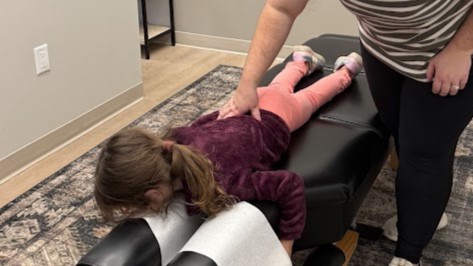
Our doctors use specific chiropractic techniques tailored to each child’s age, size, physical findings, and individual needs.
We focus on movement, musculoskeletal function, and comfort throughout the care process.
Step 4: Celebrating and Tracking Progress
As care continues, we pay attention to both clinical findings and the changes families notice at home.
We use progress assessments and INSiGHT Scans to observe physiological patterns over time.
And we love hearing about the everyday victories that mean so much to the families we serve.
The Little Wins Matter
When your child is navigating significant challenges, it’s easy to become focused on the big milestones.
The first clear sentence.
The first conversation with a friend.
The moment they can finally communicate something they’ve been trying to say.
Those are incredible moments worth celebrating.
But so are the smaller victories along the way.
Feeling more comfortable during a busy day.
Participating in a new activity.
Moving with greater ease.
Recovering more comfortably after a frustrating moment.
Finding new ways to communicate a need.
Experiencing a little more confidence in everyday life.
These victories may look different for every child, and progress can happen through many different experiences.
At Foundations Chiropractic, we love celebrating the whole child and recognizing the moments that matter most to their family.
Your Child Has So Much More to Say
One of the most important things we want families navigating childhood apraxia to remember is this:
Your child’s ability to speak does not determine how much they understand, how much they feel, or how much they have to share with the world.
Their thoughts matter.
Their personality matters.
Their interests, their excitement, and their unique way of experiencing the world matter.
And even when spoken words are difficult, communication and connection can happen in many meaningful ways.
Every child has strengths worth celebrating.
Every child has a story worth understanding.
And every child deserves to feel seen, heard, and supported.
Looking Beyond Speech Challenges at Foundations Chiropractic
If your child has been navigating significant speech delays, apraxia, motor planning difficulties, or other developmental concerns, we would love the opportunity to learn more about your family.
At Foundations Chiropractic, we’re passionate about understanding the nervous system and its important role in movement, coordination, and overall health.
Through detailed consultations, INSiGHT Scanning Technology, personalized care recommendations, and gentle, neurologically-focused chiropractic adjustments, we focus on supporting physical function and comfort in a way that’s individualized for every child.
We believe in looking beyond the label.
Listening to the parent’s story.
Recognizing the child’s strengths.
And celebrating meaningful progress throughout the journey.
Our mission is to help change the trajectory of children’s health through neurologically-focused chiropractic care.
And we’re honored to walk alongside families who are searching for a deeper understanding of their child’s health.
Because sometimes the most important thing we can do is look beyond the words a child is struggling to say and recognize the incredible person who has so much to share.
Begin Your Family’s Journey at Foundations Chiropractic
If you’re interested in learning how our neurologically-focused approach could fit your child’s individual needs, we’d love to welcome you to Foundations Chiropractic in Fountain City, Wisconsin.
Our team is passionate about helping families feel heard, understood, and supported from the very first visit.
Your child’s story matters. Their potential matters. And we’re here to help you build a strong foundation for the journey ahead.