When most people picture a chiropractic adjustment, they imagine a quick movement, a popping sound, or a doctor simply trying to change the position of a joint.
But a neurologically focused chiropractic adjustment is about so much more than that.
The true purpose of an adjustment is not the sound it makes or the amount of time it takes. It is the specific neurological input it provides to the brain and nervous system.
That small, gentle input can help the body release tension, adapt to stress, and communicate more effectively from the brain to the body and back again.
More Than a Mechanical Change
It is easy to think of an adjustment as something purely mechanical.
A joint is restricted, so the chiropractor helps restore movement.
While healthy movement is certainly important, that is only part of the story. Every joint, muscle, and surrounding tissue contains receptors that are constantly sending information to the brain.
These signals tell the brain where the body is, how it is moving, and how much tension it is carrying.
When an area of the neurospinal system becomes tense, restricted, or stressed, the information being sent to the brain can become altered. This can contribute to a pattern known as subluxation, which involves restricted motion, increased tension, and interference in the communication between the brain and body.
A specific chiropractic adjustment introduces new, healthy sensory input into that system.
The brain receives that information and begins to reassess how the body is moving, responding, and adapting.
In other words, the adjustment is not simply changing a joint.
It is changing the signal.
How an Adjustment Communicates With the Brain
The neurospinal system is filled with sensory receptors that respond to movement, pressure, and position.
During an adjustment, these receptors receive a brief and specific input. That information travels to areas of the brain involved in movement, coordination, sensory processing, attention, and regulation.
This input can help the nervous system become more aware of areas where it has been holding tension or operating inefficiently.
The process may support:
- Improved brain-body communication
- Healthier movement patterns
- Reduced neuromuscular tension
- Better nervous system adaptability
- A shift away from chronic stress responses
- Improved regulation throughout the body
This is why families may notice changes that seem unrelated to the area being adjusted.
The nervous system helps coordinate sleep, digestion, immune function, emotional regulation, movement, focus, and development. When communication within that system improves, changes may be noticed across multiple areas of a child’s health.
Why Pediatric Adjustments Are So Gentle
Many parents are understandably nervous when they first hear the word “adjustment,” especially when they are considering chiropractic care for a baby or young child.
Pediatric adjustments look very different from what most adults imagine.
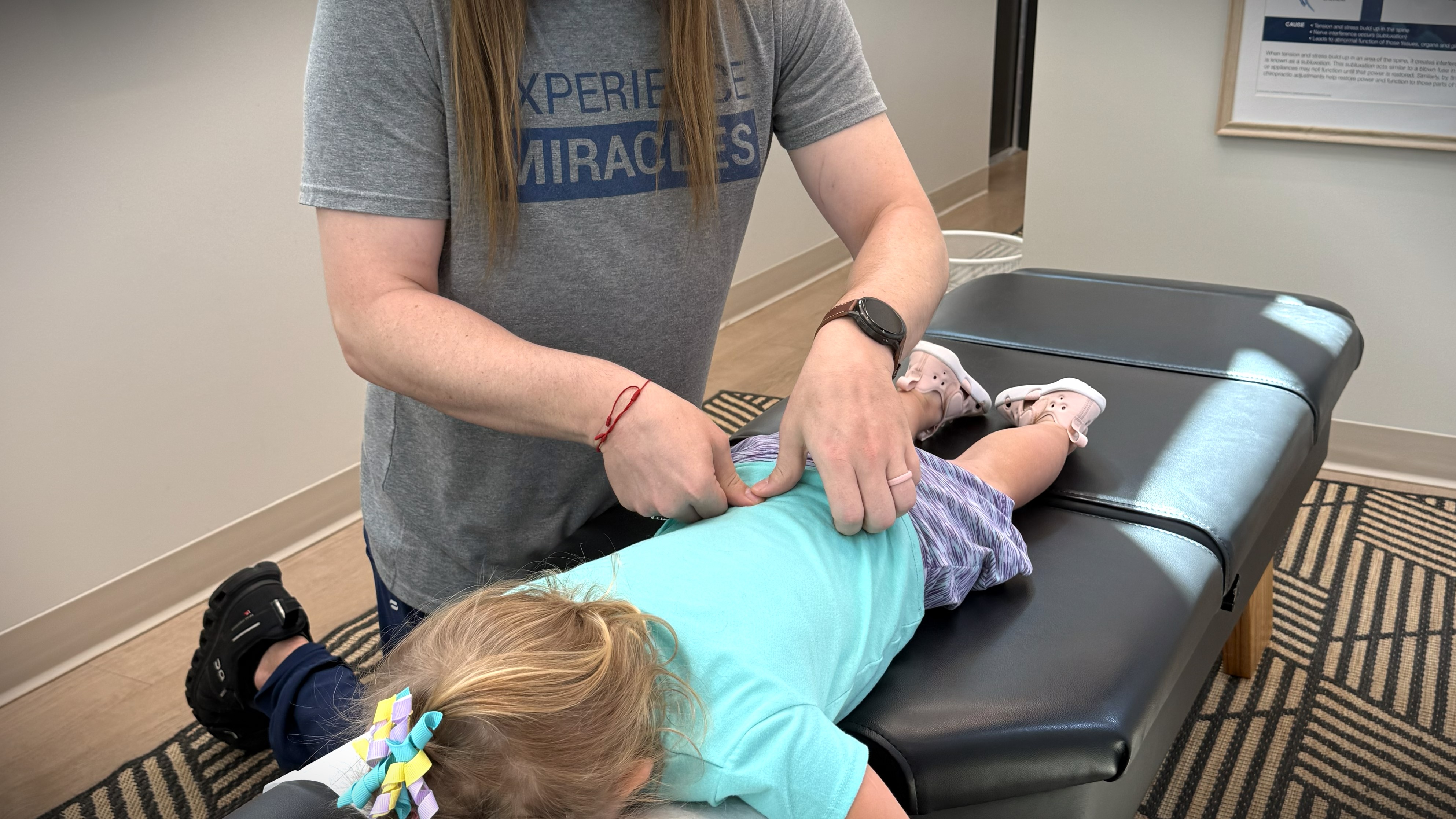
They are gentle, specific, and adapted to the child’s age, size, development, and individual nervous system needs. For infants, the amount of pressure used may be similar to what you would use to check the ripeness of an avocado.
There is no need for forceful twisting or aggressive movements.
The goal is not to overpower the body. It is to provide the right amount of input in the right place so the nervous system can recognize it, process it, and respond.
Why Is the Adjustment So Quick?
Parents occasionally watch their child’s adjustment and wonder:
“That was it?”
We understand why.
Most healthcare experiences have taught us to associate more time with more value. A physical therapy appointment may last an hour. An occupational therapy session may last 45 minutes. A massage may last 60 minutes.
Neurologically focused chiropractic care works differently.
The purpose of an adjustment is not to continuously stretch, massage, or work a muscle. It is to deliver a specific neurological input without overwhelming the system.
Many of the children we care for are already processing more input than their nervous systems can comfortably manage. They may be sensitive to noise, light, touch, transitions, busy environments, or changes in routine.
For these children, more input is not always better.
A short and specific adjustment gives the nervous system the information it needs without adding unnecessary stimulation. The brain and body can then begin integrating that input after the visit.
The adjustment may take only a few minutes.
The nervous system’s response continues long after the child leaves the office.
The Adjustment Is the Catalyst
The adjustment does not force the body to heal.
Instead, it acts as a catalyst that helps the nervous system recognize stress patterns and begin responding differently.
Think about learning a new skill.
A child does not learn to read, ride a bike, or throw a ball perfectly after one long practice session. The brain changes through specific, repeated experiences over time.
The same principle applies to nervous system regulation.
Each adjustment provides the brain with another opportunity to:
- Release stored tension
- Improve movement and sensory input
- Build healthier neurological patterns
- Increase adaptability
- Become more organized and regulated
The meaningful work often happens between visits as the brain processes and integrates the new information.
Why Frequency Matters
When families begin care, one of their most common questions is why their child may be recommended to come more frequently at first.
The answer comes down to how the nervous system learns.
Lasting neurological change is built through consistent and repeated input. One adjustment may create a positive shift, but a nervous system that has been stressed or dysregulated for months or years often needs repetition to develop a new pattern.
Everyday life continues adding stress between visits.
Children experience growth spurts, illnesses, falls, school demands, screens, emotional stress, sensory stimulation, and disrupted sleep. These stressors can quickly reload a nervous system that is already operating near its limit.
Consistent adjustments help reinforce healthier patterns before the system returns to its previous state.
Frequency is not about how much time a child spends being adjusted.
It is about giving the nervous system the right input consistently enough for that new pattern to become more stable.
How We Know What Your Child Needs
Every child’s nervous system is different.
Two children may have the same diagnosis or similar symptoms while showing completely different patterns of stress and dysregulation.
That is why we do not base care only on symptoms.
At Foundations Chiropractic, we use neurological INSiGHT Scans to better understand how each child’s nervous system is functioning and adapting.
These safe, non-invasive scans evaluate three important areas:
Heart Rate Variability
Heart rate variability, or HRV, gives us information about adaptability, energy, and balance within the autonomic nervous system.
NeuroCore sEMG
This scan measures neuromuscular activity and helps identify patterns of tension, exhaustion, imbalance, and disorganized motor control.
NeuroThermal Scanning
NeuroThermal scanning measures temperature patterns throughout the neurospinal system, helping us identify areas where autonomic regulation may be under increased stress.
Together, these scans give us an objective baseline at the beginning of care.
Progress scans allow us to see how the nervous system is changing over time and help our doctors determine whether the care plan is producing more stability, balance, and adaptability.
The scans do not diagnose a specific condition. They help us measure nervous system function so care can be individualized rather than based on guesswork.
What Changes Might Parents Notice First?
Parents are often watching for the biggest outcome first.
They may be waiting for a major developmental milestone, fewer meltdowns, better focus, or significant changes in a chronic health challenge.
Those wins can happen, but the nervous system often begins with more foundational functions.
Some of the earliest changes families report include:
- Falling asleep more easily
- Sleeping more soundly
- More regular bowel movements
- Improved appetite
- Less tension in the body
- Faster recovery from illness
- Increased energy or endurance
- A calmer and more regulated demeanor
- Easier transitions
- Improved movement and coordination
These seemingly small wins can be meaningful signs that the nervous system is beginning to function more efficiently.
The body often restores foundational functions first. As regulation improves, it may become easier for a child to make progress with focus, learning, emotions, sensory processing, and development.
A Different Way to View Chiropractic Care
Neurologically focused chiropractic care is not simply about discomfort, posture, or mobility.
It is about improving communication within the system that coordinates the entire body.
An adjustment is a short, specific neurological input. It gives the brain new information and creates an opportunity for the nervous system to release stress, reorganize, and adapt more effectively.
The adjustment begins the process.
The nervous system does the work.
That is why the adjustment itself may be quick, but the care plan must still be specific, consistent, and personalized.
If your child has tried countless therapies, dietary changes, supplements, or other interventions but continues to struggle, the missing piece may not be another downstream solution.
It may be time to look at the nervous system that helps coordinate them all.
At Foundations Chiropractic, our goal is to help families understand what is happening beneath the surface and create a personalized plan that supports each child’s ability to regulate, adapt, and thrive.