For many families, living with sensory processing challenges can feel overwhelming—everyday life becomes a maze of triggers, meltdowns, and unpredictable reactions.
This was the reality for Aria’s family. Her parents describe her as often being deeply unhappy, especially in new environments. Trips out as a family often ended in tears and frustration because she would quickly become overloaded by the noise, lights, and unpredictability around her.
What Aria was experiencing is something called Sensory Processing Disorder (SPD)—a condition where the nervous system has difficulty receiving, interpreting, and appropriately responding to input from the senses. Instead of filtering and balancing this input like most of us do automatically, a child with SPD may feel constantly “on edge” or, on the flip side, be under-responsive and crave more stimulation.
Unfortunately, many parents are told “it’s just a phase” or “they’ll grow out of it.” But the truth is, sensory challenges often grow with the child unless they’re addressed early and at the root.
What Is Sensory Processing Disorder?
Imagine walking into a carnival—blaring music, flashing lights, strong smells, and crowds everywhere. For most kids, that might be exciting. For a child with SPD, it can feel like chaos to their nervous system—triggering panic, meltdowns, or complete withdrawal.
SPD can affect any of the senses:
- Auditory: Sensitivity to noise or volume
- Visual: Discomfort with bright or flickering lights
- Olfactory: Strong aversion to certain smells
- Gustatory: Extreme pickiness about food textures
- Tactile: Discomfort with certain fabrics or unexpected touch
- Vestibular: Difficulty with balance and movement
- Proprioceptive: Trouble sensing body position and coordination
Of these, proprioception (the sense of where your body is in space) plays a huge role in brain development, movement, and emotional regulation.
While SPD can occur alongside Autism Spectrum Disorder, it is not the same thing. Many children with SPD have age-appropriate skills in some areas but still face significant sensory struggles in others.
Signs You Might Notice
Children with SPD often fall into two categories: hypersensitive (over-reactive) or hyposensitive (under-reactive). Many kids experience a mix of both.
Signs of Hypersensitivity (Oversensitivity):
- As an infant: excessive crying, difficulty feeding
- As a toddler/preschooler: meltdowns over textures, sounds, lights, or smells
- As a school-aged child: avoids crowded/noisy places, bothered by tags or fabrics, covers ears or eyes
Signs of Hyposensitivity (Undersensitivity):
- As a toddler/preschooler: craves constant movement or touch, doesn’t react to loud sounds, enjoys crashing or rough play
- As a school-aged child: chews on objects, seeks intense sensory play, takes big physical risks without fear
These sensory patterns can lead to bigger challenges over time—impacting learning, emotional regulation, social skills, family routines, and even physical health.
Why Sensory Processing Problems Happen
From our neurologically-focused perspective, SPD isn’t random—it’s often the result of cumulative stress on a child’s nervous system, starting as early as pregnancy and birth.
Some of the most common contributors we see include:
- High-stress pregnancy or birth trauma
- Early feeding or digestion struggles (colic, constipation)
- Frequent illness or antibiotic use
- Sleep challenges
- Exposure to environmental toxins
Over time, these stressors can push the nervous system into a constant “fight-or-flight” mode (sympathetic dominance) and suppress the “rest-and-digest” side (parasympathetic system). This imbalance—called dysautonomia—creates tension patterns (subluxations) that disrupt healthy sensory processing.
How Neurologically-Focused Chiropractic Care Helps
At Foundations Chiropractic, we use advanced technology called INSiGHT Scans to measure exactly how your child’s nervous system is functioning. These scans look at:
- Thermal patterns (how well the nerves controlling organs are functioning)
- Muscle activity (to find areas of imbalance and tension)
- Heart rate variability (a key measure of adaptability and regulation)
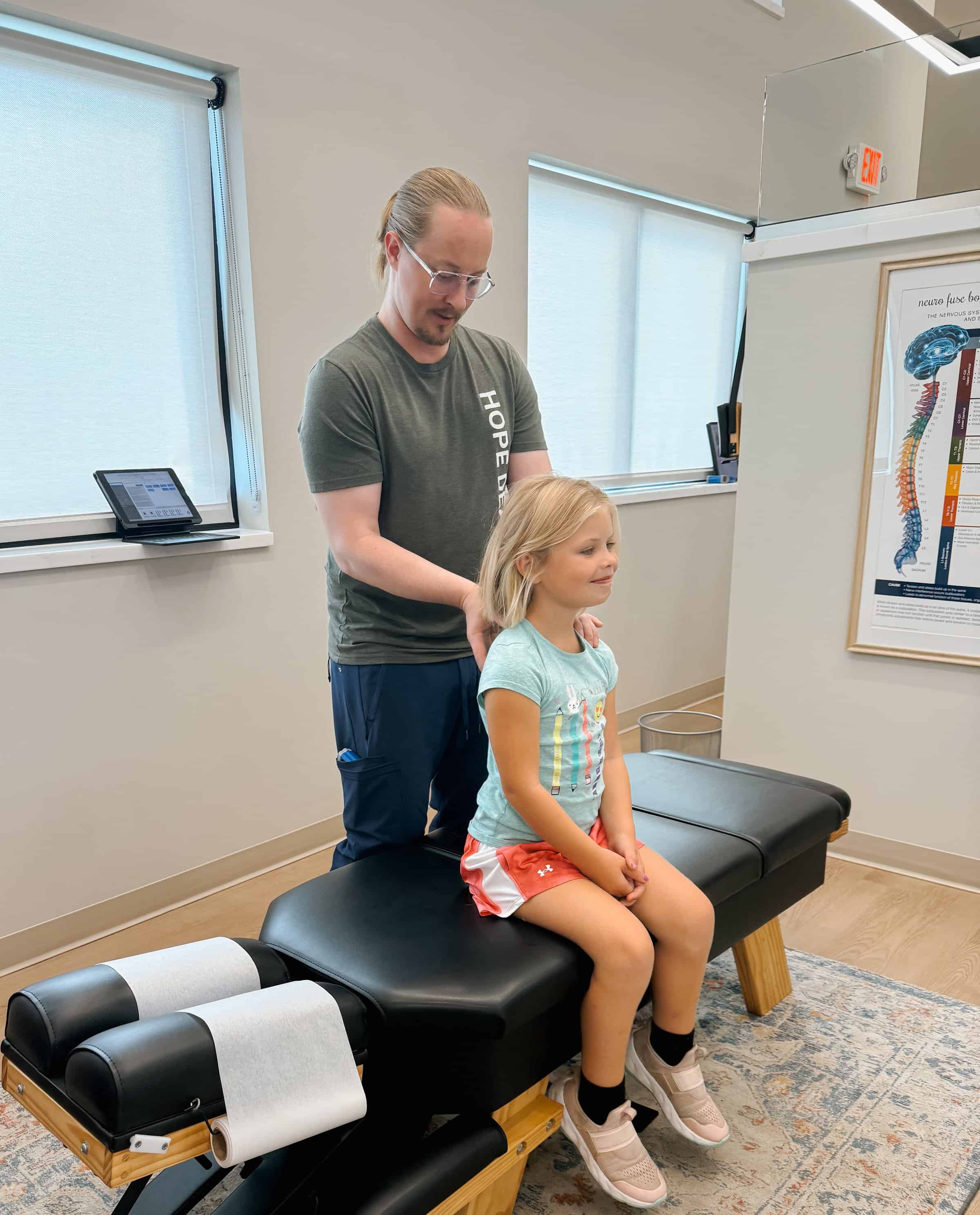
When subluxations and nervous system imbalances are present, adjustments help restore balance, calm an overactive “gas pedal,” and strengthen the “brake pedal” of the nervous system—helping your child process sensory input with more ease.
That’s exactly what happened for Aria. Over time, her fear of people and places began to melt away. She started greeting others with a smile, her sleep improved, and her speech blossomed.
A Message for Parents
If your child struggles with sensory issues, please know you’re not alone—and it’s not something you just have to “wait out.” By addressing the nervous system first, we can help unlock their ability to adapt, self-regulate, and thrive in daily life.
If you’ve been working hard with occupational or physical therapy but haven’t seen the progress you hoped for, it may be that underlying nervous system tension is holding your child back.
You don’t have to watch them miss out on experiences or carry the weight of constant meltdowns. There’s a way forward—and we’d be honored to walk it with you.
Next Step: Schedule a consultation and INSiGHT Scans with our team so we can help uncover the root cause of your child’s sensory challenges and create a plan for lasting change.