By the time a symptom shows up, your child’s nervous system has often been struggling for a while.
That’s one of the most important things we want parents to understand.
The meltdowns, constipation, sleep struggles, sensory overwhelm, chronic illness, anxiety, focus challenges, big emotions, and behavioral outbursts are not usually random. They are signs that something deeper may be going on beneath the surface.
And while symptoms matter, they do not always tell the full story.
At Foundations Chiropractic, we don’t want to guess when it comes to your child’s nervous system.
That’s why we scan.
Not to diagnose.
Not to label.
Not to make things more complicated.
We scan because the nervous system controls and coordinates every other system in the body — and when it is stuck in stress mode, the effects can show up everywhere.
Why Measuring the Nervous System Matters
Most parents are used to testing for problems after symptoms appear.
Blood work checks for disease markers.
Developmental screenings track milestones.
X-rays show structure.
Evaluations look at behavior, learning, or function.
All of those tools can be helpful.
But none of them answer one of the most important questions for a struggling child:
Is their nervous system regulating well, or is it stuck?
The nervous system controls things like:
- Sleep
- Digestion
- Immune function
- Focus
- Emotional regulation
- Stress response
- Heart rate
- Adaptability
- Healing and recovery
So when a child is struggling in multiple areas at once, we have to ask a deeper question.
What if these are not separate problems?
What if the common thread is nervous system dysregulation?
This is why measuring nervous system function can be such a powerful missing piece for families.
Parents can see the symptoms.
They can see the meltdown.
They can see the poor sleep.
They can see the constipation.
They can see the anxiety.
They can see the chronic sickness.
But what they cannot see with their eyes is how the nervous system is functioning underneath it all.
That is where INSiGHT Scans come in.
Symptoms Are Often the Last Thing to Show Up
One of the biggest misconceptions in health is that symptoms are the first sign something is wrong.
But often, symptoms are actually the last thing to appear.
A child’s nervous system may be under stress for months or even years before it becomes obvious on the outside.
Think about it like a storm.
Before the rain starts falling, the clouds have already been building. The pressure has already been changing. The storm system has already been forming.
Symptoms are the rain.
INSiGHT Scans help us see the storm patterns before we only react to the downpour.
This matters because if we only chase symptoms, we are always a few steps behind.
A child may finally sleep better, have fewer meltdowns, or poop more regularly after the nervous system has already started shifting internally. Healing often happens from the inside out, and symptoms may be the last thing to fully change.
That is why objective measurement matters so much.
It helps us track what is happening beneath the surface.
Structure and Function Are Not the Same Thing
A lot of people think chiropractic care is only about the spine.
And while the spine is incredibly important, at Foundations Chiropractic, we are not just looking at structure.
We are looking at function.
Structure tells us what something looks like.
Function tells us how something is working.
An X-ray may show the shape, curves, or alignment of the spine. But it cannot show whether your child is stuck in fight-or-flight mode. It cannot show whether their nervous system is adapting well to stress. It cannot show whether their body is burning through energy just trying to stay upright, calm, focused, or regulated.
That’s why we care so much about measuring nervous system function.
A child can have a spine that looks “fine” structurally and still have significant nervous system stress.
Because the deeper question is not just:
“What does the spine look like?”
The deeper question is:
“How is the nervous system working?”
That is the question that helps us get closer to the root.
The Gas Pedal and the Brake Pedal
One of the easiest ways to understand the autonomic nervous system is to think about a gas pedal and a brake pedal.
The sympathetic nervous system is the gas pedal.
It helps the body respond to stress. It activates fight-or-flight. It helps your child move, protect, react, and stay alert.
The parasympathetic nervous system is the brake pedal.
It helps the body rest, digest, heal, sleep, regulate, and recover.
Both systems are good.
Both are necessary.
A healthy nervous system can shift between the two.
Your child should be able to activate when needed, then calm back down when the stress has passed.
But many kids we see are stuck with the gas pedal pressed down.
Their body is constantly on alert.
That can look like:
- Difficulty falling asleep
- Waking often at night
- Constant movement
- Big emotional reactions
- Trouble focusing
- Sensory overwhelm
- Digestive issues
- Frequent illness
- Anxiety or fearfulness
- Difficulty calming down once upset
These children are not choosing to be difficult.
Their nervous system may simply be stuck in a state that makes calm, focus, digestion, and regulation much harder to access.
What Are INSiGHT Scans?
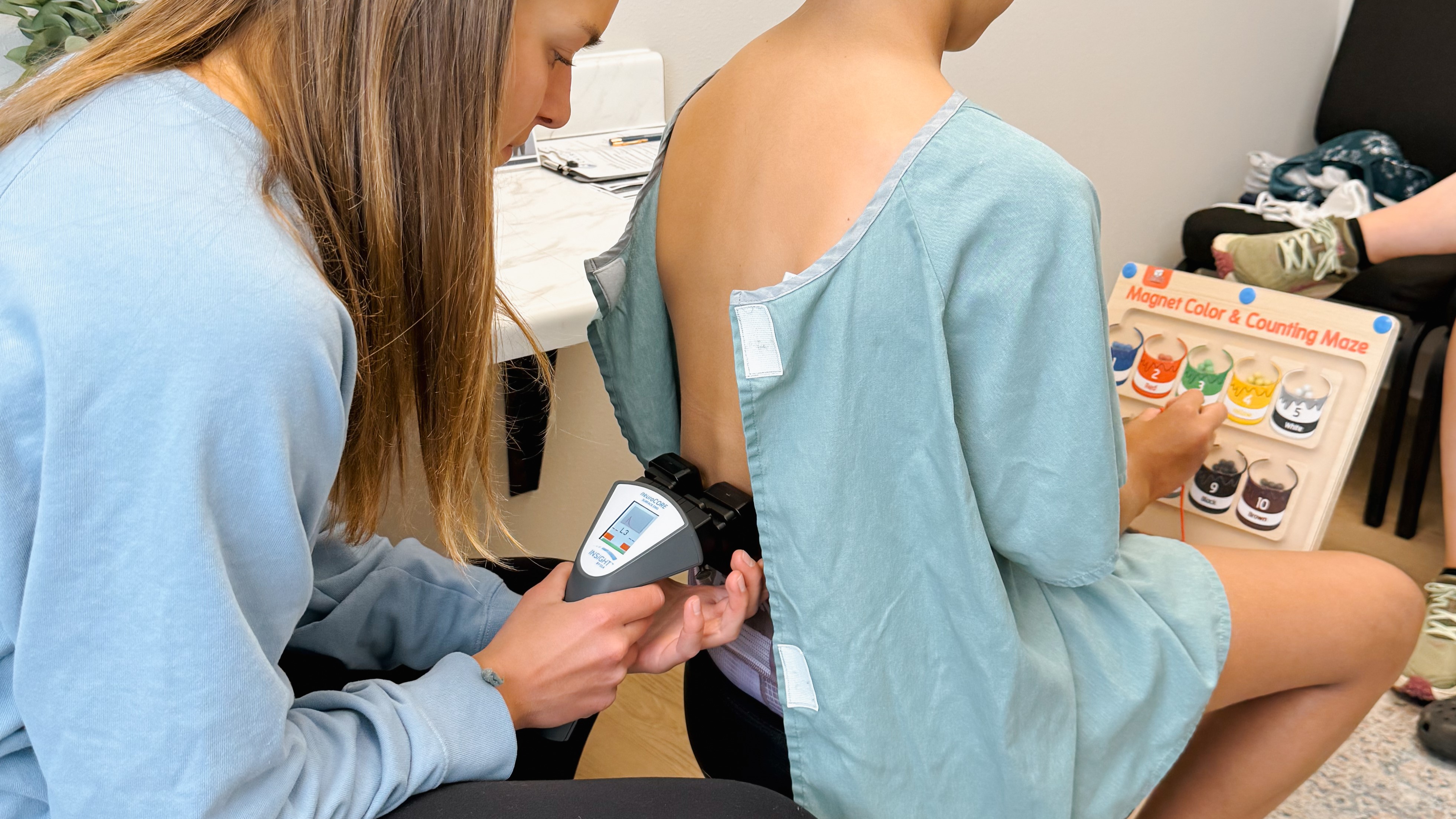
INSiGHT Scans are safe, non-invasive scans that help us measure how your child’s nervous system is functioning.
There are no needles.
No radiation.
Nothing painful.
They simply read the signals your child’s body is already giving us.
At Foundations Chiropractic, these scans help us better understand patterns of stress, tension, and dysregulation within the nervous system.
They do not diagnose medical conditions.
They do not replace your pediatrician or specialists.
They do not treat or cure conditions like ADHD, anxiety, autism, sensory processing disorder, constipation, sleep challenges, or immune struggles.
Instead, they help us objectively measure nervous system function so we can create care that is more specific, intentional, and rooted in what your child’s body is actually showing us.
What Do the Scans Measure?
INSiGHT Scans give us a three-part look at the nervous system.
Each scan answers a different question.
1. NeuroThermal Scan
The NeuroThermal Scan helps us look at patterns of stress and dysregulation within the autonomic nervous system.
Because the autonomic nervous system plays a major role in digestion, immune function, temperature regulation, and stress response, thermal patterns can help us better understand where the nervous system may be struggling to coordinate properly.
This can be especially helpful for children with challenges like colic, constipation, chronic sickness, sleep struggles, and regulation issues.
2. NeuroSpinal EMG Scan
The NeuroSpinal EMG Scan measures patterns of muscle tension along the spine.
This helps us see how much energy your child’s nervous system may be using just to hold their body upright, manage tension, and get through the day.
Some kids are burning through their reserves long before the day is over.
This scan can be especially helpful for children with sensory, motor, posture, coordination, focus, and emotional regulation challenges.
3. Heart Rate Variability Scan
Heart Rate Variability, or HRV, helps us understand how adaptable and resilient your child’s nervous system is.
In simple terms, it shows how well the nervous system can shift between stress and recovery.
A more adaptable nervous system has a greater ability to handle stress and return to calm.
A depleted or overwhelmed nervous system often has a much harder time bouncing back.
This scan is incredibly valuable because it gives us a big-picture view of nervous system regulation.
Why We Don’t Just Guess
Without scans, so much of care can become based on what we can observe from the outside.
We can listen to your story.
We can watch how your child moves.
We can feel areas of tension.
We can complete a neurological exam.
All of those pieces matter.
But scans give us objective data.
They help us see what the nervous system is doing beneath the surface.
They help us understand where stress is concentrated, how deeply the system is affected, and how much support your child may need.
In our office, we often say:
Scans help guide the plan.
They do not replace our doctors’ hands, clinical experience, or connection with your family. But they give us another layer of information that helps us be more specific and more accountable.
The Perfect Storm and Your Child’s Scan
At Foundations Chiropractic, we often talk about The Perfect Storm.
This is the stacking of stressors that can overwhelm a child’s developing nervous system.
For some kids, it starts before birth with prenatal stress or a difficult pregnancy.
For others, it may include birth stress, such as a C-section, long labor, vacuum extraction, forceps, or other interventions.
Then early childhood stressors may continue to add layers — antibiotics, chronic ear infections, digestive issues, falls, poor sleep, sensory overload, illness, or emotional stress.
Over time, the nervous system may become stuck in survival mode.
The child may not simply “grow out of it.”
Instead, the signs may change as they grow.
Colic may become constipation.
Constipation may become sensory struggles.
Sensory struggles may become focus challenges.
Focus challenges may become anxiety.
Anxiety may become emotional or behavioral overwhelm.
This is why we want to look at the nervous system early and deeply.
INSiGHT Scans help us see how The Perfect Storm may be showing up in your child’s body right now.
Why Progress Scans Matter
The first scan gives us a baseline.
But progress scans help us track change over time.
This is important because symptoms do not always change in a straight line.
Some weeks may feel amazing.
Some weeks may feel harder.
Some symptoms may improve quickly.
Others may take more time.
Progress scans help us look beyond the ups and downs of daily life and ask:
Is the nervous system becoming more regulated?
Is HRV improving?
Is muscle tension calming?
Are thermal patterns becoming more balanced?
Is the body adapting better than before?
This gives both our doctors and your family objective feedback.
If the scans are improving, it helps us see that healing is happening from the inside out — even if every symptom has not fully resolved yet.
And if the scans are not changing the way we want them to, that is important information too. It helps us adjust the care plan instead of continuing to guess.
Why Mom and Dad’s Nervous Systems Matter Too
Another powerful piece of progress scanning is that it can reveal patterns of co-regulation.
Children do not heal in isolation.
Their nervous system is constantly interacting with the nervous systems around them.
This is especially true for babies and young children, but it matters for older kids too.
If a child begins care and makes progress, but then seems to plateau, we may also want to look at the nervous systems of the parents.
Not because parents are to blame.
Not at all.
But because families regulate together.
A child’s nervous system is deeply shaped by the environment they live in. And one of the most important parts of that environment is the emotional and neurological state of the adults caring for them.
When mom or dad is stuck in stress mode too, the whole household can feel it.
And when parents begin to regulate better, the whole home often begins to shift.
This is why we love caring for the whole family.
Because healing is not just individual.
It is relational.
What Scans Help Parents Understand
For many parents, the most powerful part of scanning is not just the data.
It is the clarity.
For the first time, they can see that their child is not broken.
They can see that the meltdowns, digestive struggles, sleep issues, anxiety, sensory overload, and focus challenges may all be connected.
They can see that their child’s nervous system has been working hard.
They can see that their child is not trying to be difficult — their body has been stuck in stress.
That understanding changes everything.
It replaces blame with compassion.
It replaces guessing with direction.
It replaces symptom-chasing with a plan.
And it gives families hope that there may be a deeper way forward.
The Bottom Line: We Scan Because Your Child Deserves More Than Guesswork
Measuring nervous system function helps us answer one of the most important questions in your child’s health:
Is their nervous system regulating, or is it stuck?
That question matters because the nervous system controls so much of what parents are worried about every day.
Sleep.
Digestion.
Immunity.
Focus.
Behavior.
Emotions.
Sensory processing.
Adaptability.
At Foundations Chiropractic, we scan because we believe families deserve objective answers.
We scan because symptoms are only part of the story.
We scan because structure and function are not the same thing.
We scan because progress should be measured, not guessed.
And we scan because when we can see how the nervous system is functioning, we can create care that is more specific, more intentional, and more deeply rooted in what your child actually needs.
Your child is not broken.
Their body may simply be asking for help.
And INSiGHT Scans help us understand where to begin.