If you’re parenting a child with eczema, chances are you’ve tried just about everything.
You’ve switched laundry detergents.
You’ve bought the “clean” lotions and creams.
You’ve eliminated dairy. Maybe gluten too.
You’ve tried probiotics, supplements, food sensitivity testing, and every recommendation you could find online.
For a little while, things might improve…
Then the rash comes right back.
If this has been your family’s experience, we want you to know something important:
You’re not doing anything wrong.
In fact, you may simply be treating the symptom while missing the system that’s driving it.
Eczema Isn’t Just a Skin Problem
When most people think of eczema, they think of dry, itchy skin.
And while that’s certainly what we see on the outside, eczema is often a reflection of what’s happening on the inside.
The skin is simply where the body is showing us there’s a deeper imbalance.
At Foundations Chiropractic, we frequently see children with eczema also struggle with things like:
- Constipation
- Food sensitivities
- Recurrent ear infections
- Poor sleep
- Anxiety
- Sensory challenges
- Behavioral meltdowns
- Digestive issues
At first glance, these conditions may seem completely unrelated.
But they often have one thing in common:
A nervous system that’s stuck in stress instead of regulation.
Looking Beyond the Skin
The skin doesn’t function by itself.
It’s constantly communicating with the immune system, digestive system, and brain.
When those systems are working together well, the skin usually follows.
When they’re not, the skin often becomes one of the first places we notice something is off.
That’s why so many children continue to experience eczema even after making significant dietary changes or finding the “right” cream.
The rash isn’t always the root problem.
It’s often the messenger.
The Nervous System’s Role
Your child’s nervous system controls every major function in the body.
That includes:
- Digestion
- Immune function
- Inflammation
- Healing
- Sleep
- Stress responses
- Elimination
One of the biggest players in all of this is the vagus nerve.
The vagus nerve acts like the communication highway between the brain and many of the body’s major organs, including the digestive system.
When the nervous system is balanced, the vagus nerve helps the body digest food, absorb nutrients, eliminate waste, regulate inflammation, and support healthy immune function.
But when a child remains stuck in “fight-or-flight” mode—a state we call nervous system dysregulation—those normal healing processes begin to slow down.
Digestion suffers.
Inflammation increases.
The immune system becomes overactive.
And the skin often reflects what’s happening internally.
Why Eczema Keeps Coming Back
Many parents notice the same pattern.
The eczema improves…
Then it flares again.
Maybe it’s every spring and fall.
Maybe after an illness.
Maybe during stressful seasons.
That’s because the nervous system is constantly adapting to the world around it.
If that system is already overwhelmed, even small stressors can push it beyond what it’s able to handle.
The result?
Another flare-up.
This is why so many families feel like they’re constantly putting out fires instead of making lasting progress.
We’ve Been Looking at the Wrong Layer
Think of healing like building a house.
The skin is the roof.
The gut and immune system are the walls.
The nervous system is the foundation.
Most eczema treatments focus on the roof.
Some focus on the walls.
Very few look at the foundation.
At Foundations Chiropractic, we believe true healing happens from the inside out.
That doesn’t mean creams, nutrition, or supplements aren’t important—they absolutely are.
But if the nervous system isn’t communicating properly with the rest of the body, those interventions often have a ceiling on how effective they can be.
How Does the Nervous System Become Stressed?
Every child’s story is different.
For some, the stress begins during pregnancy.
For others, it starts during birth through difficult deliveries, prolonged labor, inductions, C-sections, or assisted births.
As children grow, repeated illnesses, antibiotics, food sensitivities, environmental toxins, injuries, emotional stress, and other life experiences can continue adding stress to an already overwhelmed nervous system.
Eventually, that stress begins showing up in different ways.
For one child, it may look like constipation.
For another, it may look like sensory challenges.
For another, it shows up on the skin as eczema.
Different symptoms.
The same underlying system.
Measuring What Most Tests Can’t
One of the most frustrating things parents hear is:
“Everything looks normal.”
Traditional testing often evaluates disease or structure.
But it doesn’t always tell us how well the nervous system is functioning.
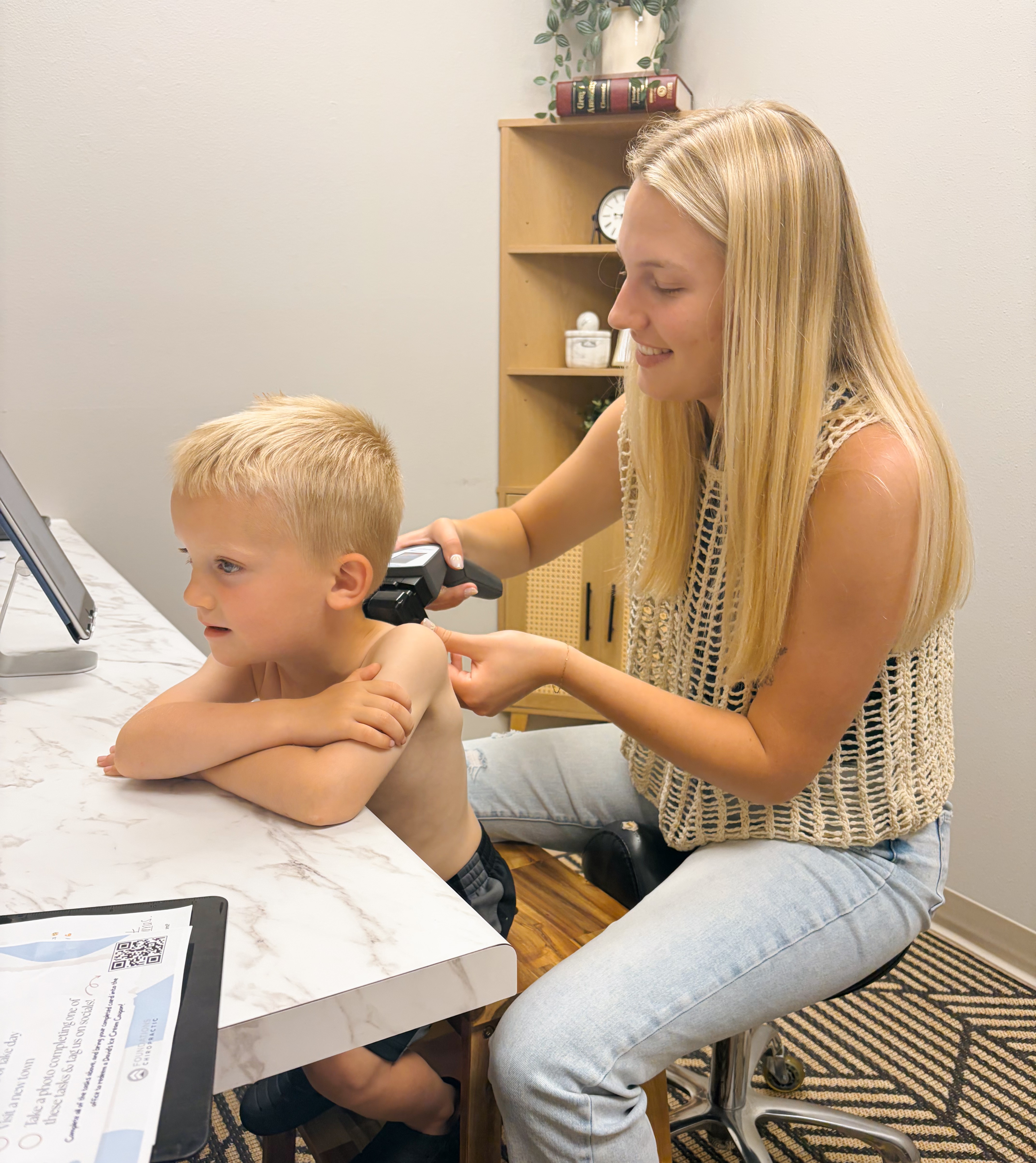
That’s why we utilize INSiGHT Scans.
These gentle, non-invasive neurological scans allow us to evaluate how your child’s nervous system is adapting to stress.
Rather than guessing, we can objectively measure patterns of nervous system dysregulation and monitor progress throughout care.
Our Goal Isn’t Just Clearer Skin
Of course, every parent wants to see their child’s eczema improve.
But our goal reaches even deeper than that.
We want to help your child’s body function the way it was designed.
When the nervous system becomes more regulated, we often begin seeing improvements that extend far beyond the skin.
Families frequently notice:
- Better sleep
- More regular bowel movements
- Fewer illnesses
- Calmer emotions
- Better focus
- Increased resilience
- More energy
- Healthier skin
Those changes aren’t separate victories.
They’re all signs that the nervous system is beginning to regulate the body more effectively.
There Is Hope
If you’ve been told your child will simply “outgrow” eczema, or you’ve felt discouraged after trying one solution after another, don’t lose hope.
Many children do experience improvement with age.
But rather than waiting and hoping, we believe it’s worth asking why the body is struggling in the first place.
When we begin supporting the nervous system—the system that coordinates digestion, immune function, inflammation, and healing—we often see changes that reach far beyond the skin.
Because eczema is rarely just about the skin.
It’s often your child’s body asking for help from the inside out.
If you’re ready to look deeper than creams, diets, and temporary fixes, our team would love to help you better understand your child’s nervous system and determine whether it could be playing a role in their healing journey.